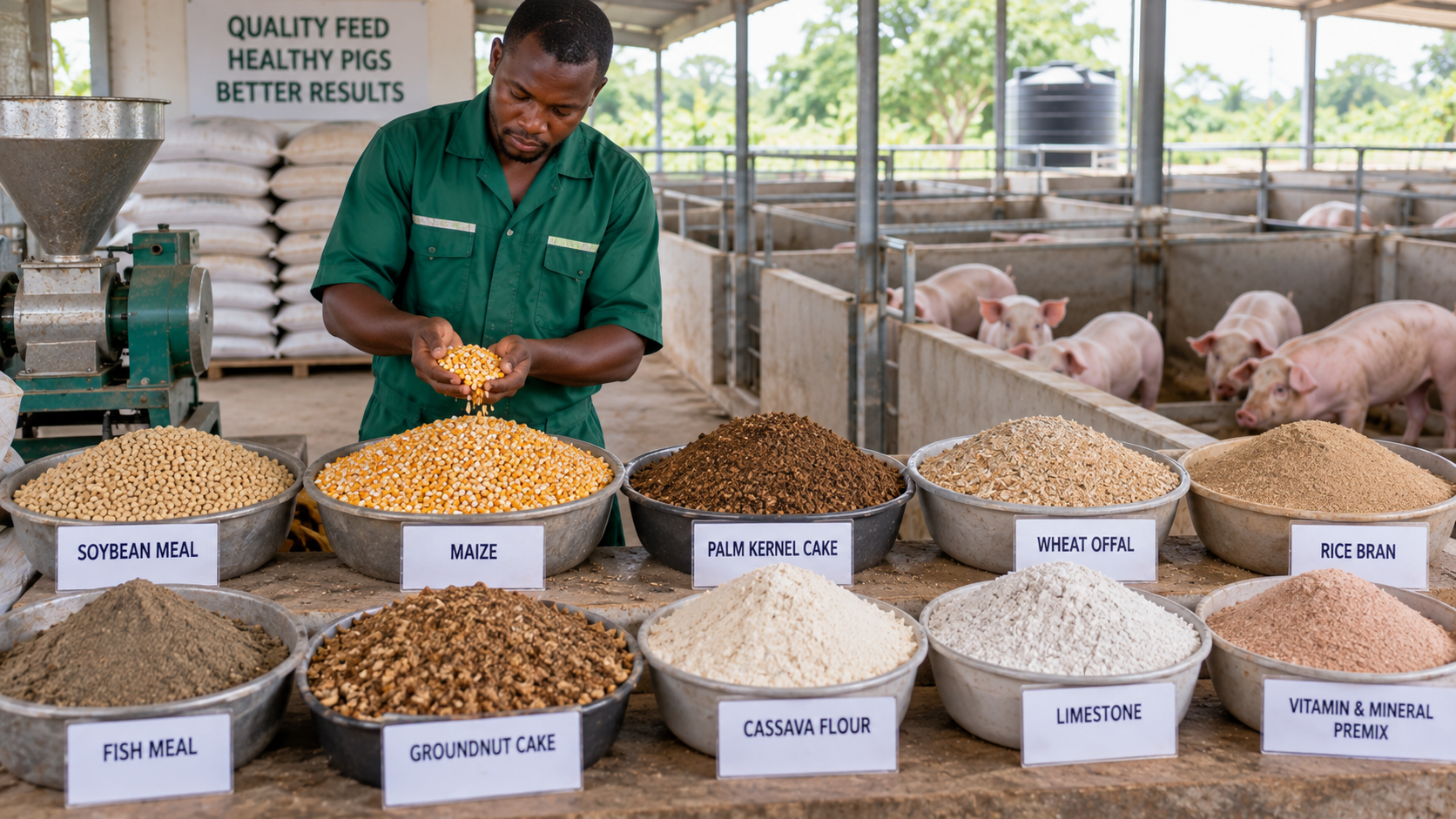
Pig Feed Ingredients and Their Functions: Complete Guide
Understanding the role of maize, soybean meal, PKC, wheat offal, amino acids, minerals and other ingredients in balanced pig feed formulation for healthy growth and efficient production.
Pig feed is more than a mixture of ingredients poured into a feed mixer.
Every ingredient in a pig diet has a purpose. Some provide energy, some supply protein and amino acids, while others provide minerals, vitamins, fibre or specific nutritional support.
Understanding the function of each ingredient is important for farmers who want to produce quality feed, control feeding costs and support healthy pig growth.
For pig farmers in Nigeria, this knowledge is particularly useful because ingredient prices, quality and availability can change from one location or season to another.
This guide explains the major ingredients commonly used in pig feed, what each ingredient contributes to the diet and what farmers should consider before including them in a feed formulation.
What Are Pig Feed Ingredients?
Pig feed ingredients are the individual raw materials used to produce a complete or supplementary pig diet.
They may include grains, cereal by-products, protein sources, oilseed meals, animal protein sources, minerals, vitamins, amino acids and feed additives.
A good pig feed formulation combines these ingredients in appropriate proportions so that the finished feed supplies the nutritional requirements of the particular class of pig.
The objective is not simply to use many ingredients.
The objective is to combine suitable ingredients to provide the required nutrients efficiently and economically.
Why Understanding Pig Feed Ingredients Matters
Two feeds can contain similar ingredients but produce different results if the ingredients differ in quality, digestibility, nutrient concentration or inclusion level.
For example, maize is an important source of dietary energy, but it does not provide all the amino acids, minerals and vitamins required by a growing pig.
Similarly, soybean meal is an important protein ingredient, but a complete pig diet still requires other nutrients and appropriate balancing.
This is why feed formulation should be based on nutrient requirements rather than simply copying a list of ingredients.
The major nutrient groups required by pigs include energy, amino acids, minerals, vitamins, fatty acids and water.
The nutritional requirements also change according to factors such as pig weight, growth stage, genetics, environment and health status.
Major Categories of Pig Feed Ingredients
Pig feed ingredients can generally be grouped according to their main nutritional functions.
1. Energy ingredients
2. Protein ingredients
3. Amino acid supplements
4. Mineral sources
5. Vitamin sources
6. Fibre sources
7. Feed additives and specialty ingredients
Let's examine the major ingredients commonly used in pig feed.
1. Maize
Maize is one of the most commonly used energy ingredients in pig diets.
Its primary function is to provide energy for maintenance, growth, movement and other body functions.
Maize is also relatively palatable to pigs and can form an important part of many complete diets.
However, maize should not be regarded as a complete feed ingredient.
Although it supplies useful energy, maize has limitations in protein quality and does not provide sufficient amounts of several essential amino acids by itself.
This means maize normally needs to be combined with suitable protein sources and other nutritional supplements.
For Nigerian pig farmers, the quality and moisture content of maize should also be considered when purchasing and storing it.
Poorly stored maize can develop mould and may become contaminated with mycotoxins.
2. Maize Offal
Maize offal is a cereal by-product commonly used in livestock feed.
It can contribute energy and fibre to pig diets and may help reduce dependence on whole maize when properly sourced and formulated.
However, maize offal is not nutritionally identical to whole maize.
Its nutrient composition can vary depending on how it was produced and what fractions of the grain are present.
Therefore, the quality of maize offal should be assessed rather than assuming that every batch has the same nutritional value.
3. Soybean Meal
Soybean meal is one of the most important protein ingredients used in pig nutrition.
Its major function is to provide protein and essential amino acids required for tissue development and growth.
Soybean meal has an amino acid profile that complements cereal grains, which is one reason cereal-soybean meal diets are widely used in pig production.
However, the nutritional value of soybean meal depends on processing and quality.
Properly processed soybean meal provides highly digestible protein, while improperly processed soybean products may contain anti-nutritional factors that interfere with nutrient utilisation.
4. Full-Fat Soybean
Full-fat soybean can provide both protein and energy because it contains the natural oil present in the soybean.
It can therefore contribute more dietary energy than conventional defatted soybean meal.
However, raw soybeans should not simply be added to pig feed without appropriate processing.
Heat treatment is important because raw soybeans contain anti-nutritional factors that can interfere with digestion and nutrient utilisation.
The processing method and quality of the soybean product should therefore be considered before use.
5. Palm Kernel Cake
Palm kernel cake, commonly called PKC, is a widely available feed ingredient in Nigeria and other palm-producing regions.
PKC can contribute protein, energy and fibre to livestock diets.
Its relatively high fibre content means that its suitability and inclusion level need to be considered according to the class of pig and the overall formulation.
The quality of PKC can also vary considerably.
Farmers should check for excessive fibre, contamination, mould, moisture and other quality problems before using it.
6. Groundnut Cake
Groundnut cake is another protein-rich ingredient used in livestock feeding.
It can contribute protein and energy to pig diets.
However, particular attention should be paid to its storage and quality because poorly stored groundnut products may be vulnerable to mould contamination and mycotoxins.
A feed ingredient can appear inexpensive but become costly if poor quality affects animal performance or feed safety.
7. Fish Meal
Fish meal is an animal protein ingredient that can supply highly valuable protein and amino acids.
It may be particularly useful in diets where high-quality protein is required.
However, fish meal quality varies considerably.
Factors such as freshness, processing method, contamination, storage and adulteration can affect its nutritional value.
Fish meal should therefore be sourced from reliable suppliers and used according to the requirements of the diet.
8. Blood Meal
Blood meal is a concentrated animal protein ingredient.
It contains a high level of protein and can contribute valuable amino acids to pig diets.
However, blood meal should be used carefully because its amino acid profile is not perfectly balanced for every pig requirement.
Its quality also depends on processing, hygiene and storage.
Animal-derived feed ingredients should be obtained from reliable sources with appropriate quality control.
9. Wheat Offal
Wheat offal is a cereal by-product commonly used in livestock feeding.
It can provide energy, protein and fibre.
Because its nutritional composition can vary, the actual quality of the product should be considered when formulating feed.
Excessive use of high-fibre ingredients can affect diet energy density and feed efficiency, particularly when the overall diet is not properly balanced.
10. Rice Bran
Rice bran can contribute energy, protein, fat and fibre to pig diets.
Its nutritional value can vary depending on the degree of milling and the amount of husk or other material present.
Freshness is also important because products containing significant amounts of oil can deteriorate during poor storage.
11. Cassava Flour and Other Cassava Products
Cassava products can provide carbohydrates and energy in pig diets.
However, cassava should be properly processed before being used as a major feed ingredient.
Different cassava products can have different nutritional characteristics, so formulation should account for the actual product being used.
Cassava flour should not simply be substituted kilogram-for-kilogram for another ingredient without considering differences in energy, protein, fibre and other nutrients.
12. Lysine
Lysine is an essential amino acid used extensively in pig feed formulation.
It is particularly important because cereal-based diets can be relatively low in lysine.
Supplemental lysine can therefore help improve the amino acid balance of a diet when used correctly.
However, adding lysine does not mean that other amino acids can be ignored.
A complete formulation must consider the relationship among essential amino acids.
13. Methionine
Methionine is another essential amino acid used in pig feed formulation.
It plays important roles in protein synthesis and metabolism.
The requirement for methionine must be considered together with cystine because these sulphur-containing amino acids are nutritionally related.
The correct amount depends on the complete diet and the nutritional requirements of the pig.
14. Threonine
Threonine is an essential amino acid required by pigs.
It contributes to protein synthesis and other physiological functions.
It can become important when diets are formulated with lower crude protein levels or when the main protein ingredients do not provide enough of the required amino acid profile.
15. Tryptophan
Tryptophan is an essential amino acid required in relatively small amounts but still important for proper nutrition.
Cereal grains such as maize may not supply enough tryptophan to meet the requirements of pigs when considered as part of an overall diet.
This is one reason balanced feed formulation is more important than simply achieving a target crude protein percentage.
16. Vitamin and Mineral Premix
A vitamin and mineral premix provides concentrated quantities of essential micronutrients.
Vitamins and minerals support many physiological functions, including bone development, metabolism, immunity, reproduction and normal body function.
Because these nutrients are normally required in relatively small quantities, premixes are used to distribute them accurately throughout the feed.
The correct premix should be selected according to the animal class and the manufacturer's specifications.
17. Limestone
Limestone is commonly used as a calcium source in animal feed.
Calcium is particularly important for skeletal development and other physiological functions.
However, calcium should be balanced with phosphorus and other nutrients rather than considered in isolation.
18. Dicalcium Phosphate
Dicalcium phosphate can provide calcium and phosphorus.
Both minerals are important in bone development and several other physiological processes.
The available phosphorus contribution of ingredients must be considered when balancing the complete diet.
19. Salt
Salt supplies sodium and chloride.
These minerals are important for fluid balance, nerve function and other physiological processes.
Salt must be included at an appropriate level because excessive or inadequate amounts can create nutritional problems.
20. Toxin Binder
Toxin binders are feed additives used in some feeding programmes to help manage certain risks associated with mycotoxins.
They should not be regarded as a replacement for good-quality raw materials and proper storage.
The best approach to feed safety begins with purchasing quality ingredients, preventing moisture problems and maintaining good storage conditions.
21. Enzymes
Enzymes may be added to pig diets to improve the utilisation of certain nutrients or feed components.
Their usefulness depends on the specific enzyme, the ingredients used and the objective of the formulation.
Enzymes should therefore be selected based on a specific nutritional need rather than added simply because they are available.
Pig Feed Ingredients and Their Main Functions
A simplified way to understand feed ingredients is to group them according to their primary role.
Energy ingredients:
Maize
Maize offal
Cassava products
Rice bran
Wheat offal
Protein ingredients:
Soybean meal
Full-fat soybean
Palm kernel cake
Groundnut cake
Fish meal
Blood meal
Amino acid supplements:
Lysine
Methionine
Threonine
Tryptophan
Other feed-grade amino acids
Mineral sources:
Limestone
Dicalcium phosphate
Salt
Mineral premixes
Vitamin sources:
Vitamin premixes
Specialised vitamin supplements where required
Functional additives:
Enzymes
Toxin binders
Other approved feed additives
Why Crude Protein Alone Is Not Enough
One of the common mistakes in pig feeding is to look only at crude protein.
A feed can contain a high crude protein percentage and still have an inadequate amino acid balance.
Pigs require specific essential amino acids, not simply a number labelled "crude protein."
Lysine, methionine, threonine, tryptophan and other essential amino acids must be considered when formulating a balanced diet.
This is particularly important when several alternative protein ingredients are being used.
The goal is to provide the pig with the right nutrients in the right balance.
Ingredient Quality Matters
The cheapest ingredient is not necessarily the cheapest ingredient to use.
A poor-quality ingredient can reduce feed value, increase wastage and negatively affect animal performance.
Before purchasing an ingredient, farmers and feed manufacturers should consider:
Moisture content
Mould contamination
Mycotoxin risk
Freshness
Odour
Colour and physical appearance
Foreign materials
Nutrient composition
Supplier reliability
Storage history
Where possible, laboratory analysis can provide useful information about nutrient composition and contamination.
Ingredient quality becomes even more important when formulating commercial feed.
How Ingredient Prices Affect Pig Feed Cost
Feed is one of the largest operating costs in pig production.
For this reason, ingredient prices have a major influence on the cost of producing pig feed.
However, the objective should not simply be to select the cheapest ingredient.
The better approach is to consider the nutrient contribution and cost of the ingredient within the complete formulation.
For example, replacing one energy ingredient with another may appear attractive because of price differences, but the replacement can change the energy, protein, fibre and nutrient balance of the complete feed.
This is why least-cost formulation should still meet the nutritional requirements of the pig.
Can One Pig Feed Ingredient Replace Another?
Sometimes an ingredient can be partially or substantially replaced by another ingredient.
However, replacement should be based on nutrient equivalence rather than weight alone.
When replacing an ingredient, consider:
Energy contribution
Protein contribution
Amino acid profile
Digestibility
Fibre level
Mineral contribution
Anti-nutritional factors
Availability
Current market price
For example, replacing maize with another energy ingredient may require adjustments to protein, amino acids or other nutrients.
A successful substitution is therefore a formulation decision, not simply a one-for-one exchange.
Pig Feed Ingredients for Different Growth Stages
Different groups of pigs have different nutritional requirements.
Starter and Weaner Pigs
Young pigs have relatively high nutrient requirements in relation to their body weight.
Their diets need highly digestible nutrients and an appropriate amino acid balance.
Ingredient quality is particularly important at this stage.
Grower Pigs
Growers need a balanced supply of energy, amino acids, minerals and vitamins to support rapid tissue development.
As pigs become larger, their nutrient requirements change.
Finisher Pigs
Finisher diets are designed to support continued growth and efficient production as pigs approach market weight.
Feed cost and feed efficiency become especially important during this stage.
Gestating Sows
Gestating sows require a diet that supports maintenance, pregnancy and the developing litter without unnecessary nutrient excess.
The formulation must take body condition, stage of gestation and other production factors into consideration.
Lactating Sows
Lactating sows have high nutrient demands because they must support milk production while maintaining their own body condition.
Energy, amino acids, minerals, vitamins and adequate feed intake are all important.
Boars
Breeding boars require adequate nutrition to maintain body condition, reproductive performance and general health.
Their diet should be formulated according to their role, body condition and management system.
Common Mistakes When Selecting Pig Feed Ingredients
Mistake 1: Choosing ingredients only because they are cheap
Price should be considered alongside nutrient value and quality.
Mistake 2: Looking only at crude protein
Protein percentage does not tell the whole story.
Amino acid balance is critical.
Mistake 3: Assuming every batch has the same nutrient value
Ingredient composition can vary between suppliers and batches.
Mistake 4: Ignoring storage conditions
Moisture, mould and poor storage can reduce ingredient quality.
Mistake 5: Making large substitutions without reformulating
Changing a major ingredient can change the nutritional balance of the entire diet.
Mistake 6: Using poor-quality animal protein ingredients
Animal-derived ingredients require particular attention to hygiene, processing and supplier quality control.
Mistake 7: Ignoring the pig's production stage
A formulation suitable for finishers may not be appropriate for young pigs or breeding animals.
Mistake 8: Adding supplements without considering the complete diet
More of a nutrient is not automatically better.
The complete diet must be balanced.
How to Build a Better Pig Feed Formulation
A practical formulation process should begin with the nutritional requirements of the pig.
Next, identify available ingredients and their nutrient values.
Then compare their cost and nutritional contribution.
After that, combine suitable energy and protein ingredients and balance the essential amino acids, minerals and vitamins.
Finally, review the complete formulation for nutrient balance, ingredient quality, cost and suitability for the particular class of pig.
The formulation should also be reviewed whenever major ingredient prices or ingredient sources change.
Why Proper Feed Formulation Matters to Pig Farmers
Good feed formulation is not simply about making pigs eat more.
The objective is to provide the nutrients required for healthy growth and efficient production while controlling feed cost.
A well-formulated diet can help farmers make better use of available ingredients, reduce unnecessary nutrient excesses and manage feed expenditure more effectively.
For commercial pig production, even a small improvement in feed efficiency can have a meaningful effect on overall production economics.
Pig Feed Ingredients and RTG Swine Concentrate
For farmers who prefer using a concentrate-based feeding programme rather than sourcing and balancing every micro-ingredient independently, a quality swine concentrate can simplify feed preparation.
RTG Swine Concentrate is designed to be used as part of a properly formulated pig diet.
The concentrate is combined with appropriate locally available feed ingredients according to the recommended feeding or mixing instructions.
Farmers should always follow the product-specific instructions supplied by the manufacturer rather than guessing the inclusion rate.
The objective is to ensure that the final feed contains the appropriate nutritional balance for the target class of pigs.
Final summary
Understanding pig feed ingredients and their functions is one of the foundations of successful pig nutrition.
Maize can provide energy.
Protein ingredients such as soybean meal and groundnut cake contribute protein and amino acids.
Ingredients such as PKC, wheat offal and rice bran can contribute useful nutrients when properly incorporated into a balanced formulation.
Amino acids such as lysine, methionine, threonine and tryptophan help correct specific nutritional gaps.
Minerals and vitamins support essential physiological functions.
Feed additives such as enzymes and toxin-management products may provide additional benefits when appropriately selected.
The important lesson is that no single ingredient can provide everything a pig needs.
Successful pig feeding depends on combining ingredients according to nutrient requirements, ingredient quality, pig production stage and feed economics.
For Nigerian pig farmers, understanding the function of each ingredient can also make it easier to evaluate alternative ingredients when prices or availability change.
The goal should always be a balanced, safe and economically sensible feed programme that supports healthy pigs and efficient production.
Related Articles
 Livestock Nutrition
RTG SWINE CONCENTRATE IN NIGERIA: A PRACTICAL GUIDE FOR PIG FARMERS
A practical guide to choosing and using pig feed concentrate in Nigeria, understanding feeding stages and making better decisions about swine nutrition and feed efficiency.
 Livestock Nutrition
STARTER, GROWER AND FINISHER PIG FEED: UNDERSTANDING THE DIFFERENT FEEDING STAGES
Feeding pigs properly is one of the most important responsibilities of a successful pig farmer. However, good pig feeding is not simply about giving pigs as much feed as possible. It is about understanding what pigs need at different stages of growth and providing nutrition that supports efficient development. A young pig has different nutritional requirements from a growing pig. Likewise, a pig approaching market weight does not necessarily require exactly the same feeding programme as a younger animal.
 Livestock Nutrition
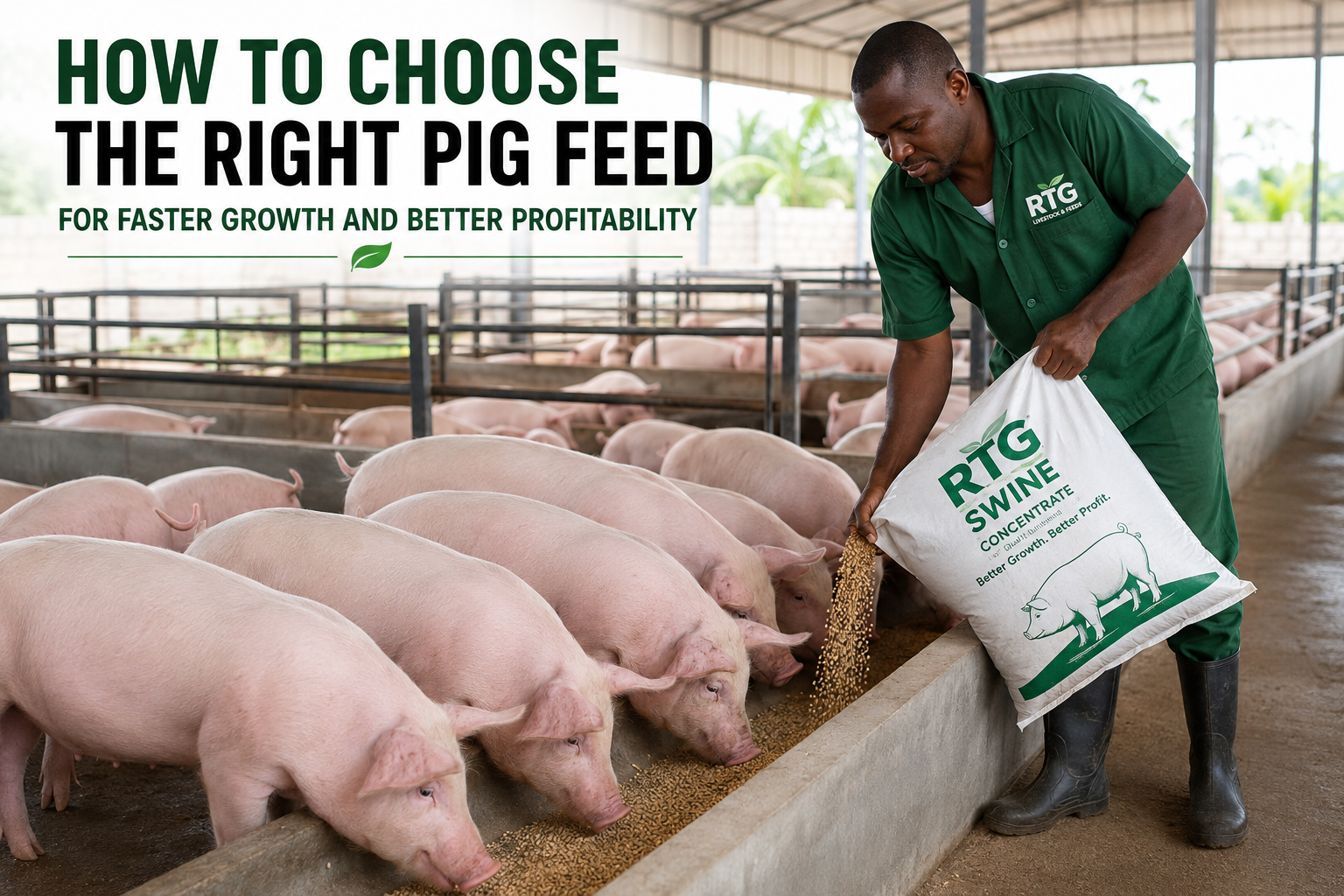
HOW TO CHOOSE THE RIGHT PIG FEED FOR FASTER GROWTH AND BETTER PROFITABILITY
Pig feed is one of the most important factors determining the success or failure of a pig farming business. A farmer may have good housing, healthy pigs and adequate management, but poor nutrition can still lead to slow growth, unnecessary feed wastage and reduced profitability. Choosing the right pig feed is therefore not simply about finding the cheapest feed available. It is about selecting a nutritionally suitable feed that matches the age, weight and production stage of the pig.