Farmer Education in Pig Farming: The Knowledge Every Successful Pig Farmer Needs
Learn why continuous farmer education matters and the essential knowledge pig farmers need for better animal care, farm management, productivity and profitability.
Farmer Education in Pig Farming: The Knowledge Every Successful Pig Farmer Needs
Pig farming is not simply about buying piglets, providing feed and waiting for them to grow.
Successful pig farming requires knowledge.
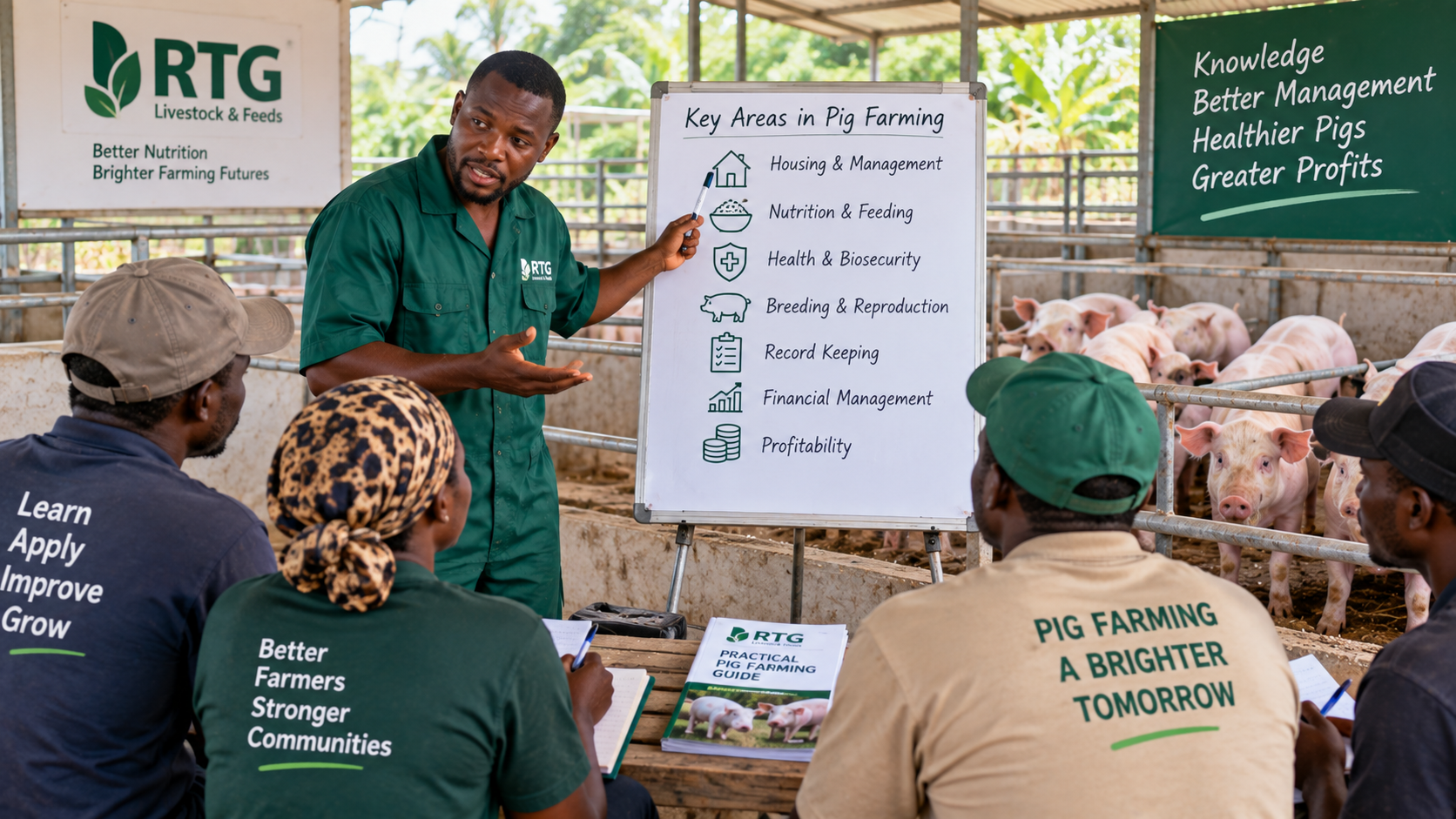
A farmer needs to understand animal behaviour, housing, hygiene, feeding, health management, breeding, farm records, financial management and marketing.
This is why farmer education is an important part of building a productive and sustainable pig farm.
A farmer who continues to learn is better positioned to identify problems early, make informed decisions, avoid unnecessary losses and adapt to changing conditions.
For Nigerian pig farmers, continuous education can be particularly valuable because production costs, input prices, disease risks, market conditions and available technologies can change over time.
What Is Farmer Education?
Farmer education is the process of acquiring the knowledge, skills and practical understanding needed to make better decisions in farming.
It does not necessarily mean sitting in a classroom for years.
Farmer education can come through:
Practical farm training
Workshops
Farmer field schools
Extension services
Experienced farmers
Veterinary professionals
Agricultural consultants
Demonstration farms
Farmer associations
Online courses
Agricultural articles
Videos and webinars
Farm records and performance analysis
Practical experimentation
The most useful education is education that helps the farmer solve real problems.
The goal is not simply to know more.
The goal is to farm better.
Why Farmer Education Matters in Pig Farming
Pig farming involves many decisions.
What breed should be used?
How should the piggery be designed?
How should new pigs be introduced?
What feeding programme should be used?
How can disease risks be reduced?
When should pigs be treated?
How should breeding animals be selected?
How much does it actually cost to produce a market pig?
What records should be kept?
When should pigs be sold?
These decisions can have financial consequences.
A farmer who understands the principles behind these decisions can evaluate situations more effectively instead of depending entirely on guesswork.
Education also helps farmers distinguish between traditional practices, personal experience and practices supported by reliable evidence.
Experience Is Valuable, But Experience Alone Is Not Enough
Experience is one of the greatest assets a farmer can develop.
A farmer who has spent years working with pigs may recognise problems that a beginner would easily miss.
However, experience can also have limitations.
A farmer may become accustomed to doing something in a particular way simply because it has always been done that way.
Agriculture continues to change.
New genetics, equipment, management systems, disease-control approaches, record-keeping tools and production technologies continue to develop.
This means experienced farmers also need continuous learning.
The best combination is practical experience supported by a willingness to learn, test ideas and improve.
What Should a Pig Farmer Learn?
A well-rounded pig farmer should develop knowledge in several important areas.
These include:
Pig breeds and genetics
Pig housing
Pig nutrition
Animal health
Biosecurity
Breeding
Piglet management
Farm hygiene
Waste management
Farm records
Financial management
Marketing
Labour management
Risk management
Farm planning
A farmer does not need to become a veterinarian, nutritionist, engineer and accountant at the same time.
However, understanding the basic principles in each area helps the farmer know when to seek specialised assistance.
1. Learn About Pig Breeds and Genetics
Breed selection can influence growth, reproductive performance, litter characteristics, body composition and other production traits.
A farmer should therefore understand the characteristics of the genetics being used on the farm.
Important questions include:
What type of pig am I raising?
What are its production characteristics?
Is it suitable for my production system?
What are the strengths and limitations of the breeding stock?
Are replacement animals being selected carefully?
Understanding genetics can help farmers make better breeding decisions instead of selecting animals based only on appearance.
2. Learn Proper Pig Housing
Housing affects pig comfort, hygiene, temperature control, ventilation, movement and disease management.
A good pig farmer should understand the purpose of different housing areas and how the design affects daily management.
Important areas include:
Ventilation
Drainage
Flooring
Pen space
Feeder placement
Water access
Cleaning
Waste removal
Isolation areas
Piglet housing
Breeding areas
The objective should be to create an environment that supports good husbandry and makes routine farm operations easier.
3. Learn Pig Health Management
Disease can cause some of the most serious losses on a pig farm.
Farmers should learn to recognise abnormal behaviour and physical signs early.
They should understand basic indicators such as:
Loss of appetite
Coughing
Diarrhoea
Vomiting
Lameness
Skin abnormalities
Fever
Respiratory difficulty
Sudden deaths
Poor growth
Reduced reproductive performance
Early recognition does not mean the farmer should attempt to diagnose every disease without professional assistance.
Rather, it means the farmer should know when something is wrong and seek appropriate veterinary advice quickly.
4. Learn Biosecurity
Biosecurity is one of the areas where farmer education can make a major difference.
Biosecurity involves measures designed to reduce the introduction and spread of disease.
Farmers should understand:
Visitor control
Quarantine
Cleaning and disinfection
Equipment hygiene
Movement of pigs
Feed and water hygiene
Carcass disposal
Rodent and pest control
Worker hygiene
Isolation of sick animals
In Nigeria, the importance of practical farmer education around pig disease prevention has been highlighted by recent national efforts involving FAO and Nigerian livestock authorities, including training on biosecurity, husbandry practices and African Swine Fever prevention and control. 1
Biosecurity is not something that should be considered only when disease is already present.
It should be part of everyday farm management.
5. Learn Pig Feeding Management
Although this article is not about feed formulation, feeding remains an important part of farmer education.
A farmer should understand:
Different feeding stages
Feed quality
Feed storage
Feed wastage
Feeding frequency
Water availability
Body condition
Feed intake
Growth monitoring
The farmer does not necessarily need to formulate every feed personally.
But understanding feeding principles makes it easier to identify problems and communicate effectively with nutritionists, feed manufacturers and suppliers.
6. Learn Pig Breeding Management
Farmers keeping breeding animals need to understand the basics of reproductive management.
This includes:
Heat detection
Mating management
Pregnancy management
Gestation
Farrowing
Colostrum management
Litter management
Weaning
Replacement selection
Poor breeding management can reduce the number of piglets produced and increase production costs.
Education therefore plays an important role in helping farmers improve reproductive management.
7. Learn Piglet Management
Piglets require careful management from birth.
Farmers should understand the importance of:
Colostrum intake
Warmth
Hygiene
Navel care
Monitoring
Identification
Appropriate feeding
Health observation
Creep feeding where applicable
Weaning management
Small management failures during the early stages can have consequences later in the production cycle.
8. Learn Farm Record Keeping
A pig farm should not be managed entirely from memory.
Farmers should record important information such as:
Number of pigs
Births
Deaths
Mating dates
Farrowing dates
Weaning dates
Feed purchases
Feed usage
Medication
Vaccination
Pig sales
Pig purchases
Labour costs
Other farm expenses
Records allow the farmer to compare actual performance with expectations.
They also help reveal problems that may otherwise remain hidden.
For example, a farmer may believe the farm is profitable because pigs are being sold regularly.
But proper records may reveal that feed, medication, labour and other expenses are consuming most of the revenue.
9. Learn Farm Financial Management
Pig farming is a business as well as a biological activity.
A farmer should understand:
Revenue
Variable costs
Fixed costs
Gross margin
Cash flow
Cost per pig
Cost per kilogram of gain
Break-even point
Profit
This does not require complicated accounting software.
Even a simple farm record system can provide useful information.
The important thing is to record actual numbers and use them to make decisions.
10. Learn How to Monitor Pig Performance
Farmers should not wait until pigs reach market weight before evaluating performance.
Regular monitoring can include:
Body weight
Growth rate
Feed intake
Mortality
Health problems
Reproductive performance
Litter size
Weaning performance
Feed wastage
Performance records can help identify problems earlier.
For example, if pigs are consuming feed but growth is below expectation, the farmer can investigate possible nutritional, health, environmental or management causes.
11. Learn to Identify Problems Early
One of the most valuable farming skills is the ability to notice when something has changed.
A farmer should know what normal behaviour looks like.
Then abnormal behaviour becomes easier to identify.
Examples include:
Pigs suddenly eating less
More pigs lying down than usual
Increased fighting
Coughing
Loose stool
Unusual deaths
Reduced water consumption
Poor growth
Pregnancy problems
Changes in piglet survival
The earlier a problem is noticed, the sooner appropriate action can be taken.
12. Learn From Other Farmers
Farmer-to-farmer learning can be extremely valuable.
A farmer may learn practical solutions by visiting another farm and observing how a problem is managed.
However, farmers should avoid copying another farm blindly.
A practice that works on one farm may not work in another because of differences in:
Climate
Genetics
Housing
Disease status
Labour
Feed availability
Farm size
Management system
Market conditions
The better approach is to learn the principle and determine whether it is appropriate for your own farm.
13. Practical Training Is More Valuable Than Theory Alone
Agricultural education becomes more useful when farmers can connect knowledge to practical situations.
This is one reason practical farmer-learning approaches are widely used.
FAO describes Farmer Field Schools as participatory learning environments where farmers observe, experiment, discuss results and make decisions in a practical setting. 2
For pig farmers, practical training could include:
Identifying pig breeds
Body condition scoring
Pig handling
Housing inspection
Biosecurity procedures
Farm sanitation
Record keeping
Piglet management
Breeding management
Disease observation
Feed management
Farm costing
The farmer should leave the training knowing not only what to do, but why it should be done.
14. Learn How to Ask the Right Questions
Good farmers do not pretend to know everything.
They ask questions.
A farmer should be comfortable asking:
Why is this pig growing slowly?
Why is feed consumption increasing?
Why are piglets dying?
Why is conception rate falling?
Why are pigs coughing?
Why is mortality increasing?
Why has the cost of production increased?
Why are some pigs performing better than others?
Asking the right question is often the beginning of solving the right problem.
15. Use Reliable Sources of Information
Not every farming claim found online is reliable.
Farmers should learn to evaluate information before applying it to their farms.
Consider:
Who provided the information?
What experience or expertise do they have?
Is the information supported by evidence?
Is the recommendation appropriate for the local environment?
Does it apply to the particular class of pigs?
Is the information current?
Can the recommendation be safely tested?
This is particularly important when dealing with animal health, medications, disease control and nutritional decisions.
16. Learn From Your Own Farm
One of the most powerful educational resources a farmer has is the farm itself.
Records can become a learning tool.
For example, a farmer can compare:
Growth between batches
Mortality between periods
Feed consumption
Feed costs
Breeding performance
Piglet survival
Market prices
Cost of production
The farm becomes a practical laboratory where management decisions can be evaluated.
The key is to change one thing at a time where possible and record the outcome.
17. Farmer Education Should Continue Throughout the Farming Career
Learning should not stop after completing one training programme.
The farmer should continue learning as the farm develops.
A beginner may initially need to learn:
Basic pig husbandry
Housing
Feeding
Health
Breeding
As the farm grows, the farmer may need to learn:
Farm economics
Staff management
Production planning
Record analysis
Marketing
Risk management
Business expansion
Education should therefore grow with the farm.
18. Digital Education Is Changing Farming
Farmers now have access to educational resources through:
Websites
Online courses
Webinars
YouTube
WhatsApp groups
Digital farm records
Online communities
Agricultural apps
E-books
Technical publications
This creates opportunities for farmers who may not have access to regular physical training.
However, digital information still needs to be evaluated carefully.
A farmer should distinguish between educational information and unverified advice.
19. Farmer Associations Can Support Learning
Farmer groups can provide opportunities for:
Knowledge sharing
Farm visits
Training
Bulk purchasing
Market information
Experience sharing
Problem solving
Networking
Learning becomes especially valuable when farmers discuss actual challenges rather than only theoretical subjects.
20. Build a Personal Learning Plan
A farmer does not need to learn everything at once.
A simple learning plan can help.
For example:
Month 1:
Pig housing and hygiene
Month 2:
Pig health and biosecurity
Month 3:
Pig nutrition and feeding management
Month 4:
Breeding and piglet management
Month 5:
Farm records
Month 6:
Farm financial management
Month 7:
Pig marketing
Month 8:
Farm improvement and expansion
The farmer can then revisit each area regularly.
The goal is continuous improvement.
21. From Knowledge to Action
Knowledge only becomes valuable when it is applied.
After learning something new, ask:
What can I improve on my farm?
What problem will this solve?
How much will the change cost?
What result should I expect?
How will I measure the result?
When will I review the outcome?
This turns education into practical farm improvement.
22. The Role of Agricultural Professionals
Farmers should not be expected to solve every technical problem themselves.
Veterinarians, animal nutritionists, agricultural extension officers, consultants and other professionals can provide specialised support.
The farmer's role is to understand enough to recognise problems, maintain good records and provide accurate information when professional help is needed.
A well-educated farmer is therefore not someone who never asks for help.
It is someone who knows when help is needed and knows the right questions to ask.
23. Education Can Help Reduce Avoidable Losses
Many farm losses are not caused by one major mistake.
They can result from a series of small management problems.
Examples include:
Poor hygiene
Poor records
Feed wastage
Late disease recognition
Poor breeding decisions
Inadequate biosecurity
Poor piglet care
Poor financial planning
Continuous education can help farmers recognise these problems and develop better systems.
24. The Goal of Farmer Education Is Better Decision-Making
The ultimate purpose of farmer education is not certificates.
It is better decisions.
A farmer who understands the farm can make decisions based on evidence rather than guesswork.
This can influence:
When to buy pigs
Which animals to retain
How to manage breeding
When to seek veterinary assistance
How to monitor growth
How to manage expenses
When to sell pigs
Whether to expand
Where to invest
Good farming decisions begin with good information.
25. What Makes a Successful Pig Farmer?
There is no single characteristic that guarantees success in pig farming.
But successful farmers tend to develop several important habits.
They observe.
They keep records.
They ask questions.
They learn.
They monitor results.
They identify problems early.
They seek professional assistance when necessary.
They evaluate costs.
They adapt when circumstances change.
Most importantly, they do not assume that because something has always been done one way, it must always remain that way.
A Farmer Who Learns Can Build a Better Farm
Pig farming is a continuous learning process.
The farmer who learns about the animals becomes better at animal management.
The farmer who learns about disease becomes better prepared to protect the herd.
The farmer who learns about farm records becomes better at measuring performance.
The farmer who learns about business becomes better at controlling costs.
And the farmer who continues learning can make better decisions as the farm grows.
Farmer education should therefore not be seen as something separate from pig farming.
It is part of pig farming.
Final Thoughts
Good pig farming requires more than capital, land, pigs and feed.
It requires knowledge.
A farmer needs to understand the animals, the production system, the risks, the costs and the market.
Continuous farmer education helps bridge the gap between simply keeping pigs and managing a pig enterprise.
The most useful education is practical, relevant and connected to real farm problems.
For Nigerian pig farmers, this means learning from experienced farmers, agricultural professionals, reliable educational resources, farmer associations and practical training opportunities.
It also means learning from the farm itself by keeping records, monitoring performance and reviewing the results of management decisions.
The farmer who continues to learn is better prepared to adapt.
And in a farming business where conditions can change, the ability to learn and adapt is one of the most valuable skills a farmer can develop.
At RTG Livestock & Feeds, we believe that better livestock production begins with better knowledge, better management and access to reliable agricultural information.
Keep learning.
Keep observing.
Keep improving.
Build your farm on knowledge, not guesswork.